
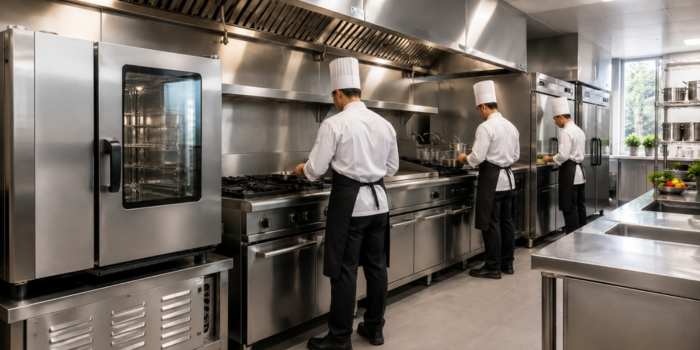
When a food business starts producing meals in large quantities, the kitchen needs to be planned differently from a normal restaurant kitchen. Large-scale food production requires more space, stronger equipment, better storage, and a clear workflow. Without proper planning, staff may waste time moving between workstations, production can become slow, and food quality may not remain consistent.
A well-designed kitchen helps employees work comfortably while allowing the business to prepare large quantities of food safely and efficiently. Whether it is a central kitchen, catering facility, hotel kitchen, food production unit, or large restaurant, good planning can make daily operations much easier.
Understand Your Production Requirements
The first step is to understand how much food your kitchen needs to produce every day. The equipment, storage, preparation areas, and cooking stations should be selected according to your production volume.
Think about the number of meals you prepare during normal days and busy periods. You should also consider future growth. A kitchen designed only for today’s production may become difficult to manage when the business receives more orders.
Planning production capacity in advance helps you choose suitable Large-Scale Food Production Equipment without wasting valuable space or money.
Create a Simple Kitchen Workflow
A high-efficiency kitchen should have a clear movement of food from one stage to another. Ingredients should enter the kitchen, move to storage, then go to preparation and cooking before reaching packing or serving areas.
A simple workflow can look like:
Receiving → Storage → Preparation → Cooking → Portioning → Packing → Dispatch
This type of layout reduces unnecessary movement and helps employees complete their tasks faster.
When the workflow is properly planned, raw ingredients and finished food can also be kept separate, which helps improve hygiene and food safety.
Plan Different Work Zones
A large production kitchen should not depend on one large open workspace. Different activities should have their own areas.
The kitchen may include preparation zones, cooking sections, storage areas, washing areas, packing stations, and dispatch spaces.
Separating these activities makes the kitchen easier to manage. It also allows several teams to work at the same time without disturbing each other.
Choose Equipment Based on Production Volume
Equipment selection should always match the amount of food you produce.
For large-scale operations, small household appliances are not suitable. The kitchen needs equipment that can handle continuous use and large quantities.
Depending on the menu, the kitchen may require commercial cooking ranges, large-capacity ovens, steamers, fryers, tilting pans, rice cookers, mixers, grinders, and food processors.
Good Commercial Kitchen Solutions should improve production speed while maintaining consistent cooking results.
Invest in High-Capacity Food Preparation Equipment
Food preparation can take a large amount of time when producing hundreds or thousands of meals.
Commercial vegetable cutters, food processors, dough mixers, meat grinders, slicers, and other preparation machines can reduce manual work.
These machines are particularly useful when the same ingredients need to be prepared repeatedly. They can help employees complete preparation work faster and produce more consistent results.
Use Efficient Cooking Stations
Cooking areas should be designed according to the type of food being produced.
A kitchen may have separate stations for boiling, frying, grilling, steaming, baking, and other cooking methods.
Placing commonly used equipment close to the relevant preparation areas can save staff time. It also reduces unnecessary movement during busy production hours.
High-quality Industrial Kitchen Equipment is designed to handle heavy workloads and can support continuous food production.
Plan Refrigeration Carefully
Large-scale kitchens need sufficient cold storage because they may handle large quantities of meat, vegetables, dairy products, sauces, and prepared ingredients.
Depending on production requirements, the facility may need commercial refrigerators, freezers, walk-in cold rooms, and preparation refrigerators.
Storage capacity should be planned based on daily production and expected stock levels. Proper organization also makes it easier for employees to find ingredients and manage inventory.
Include Enough Dry Storage
Dry ingredients such as rice, flour, pulses, spices, sugar, and packaging materials need proper storage.
Strong storage racks help keep products organized and protected from moisture. The storage area should also provide enough space for employees to move safely and access ingredients easily.
A well-managed storage system can reduce food waste and make stock control easier.
Focus on Stainless Steel Construction
Stainless steel is widely used in professional food production environments because it is durable, hygienic, and easy to clean.
Work tables, sinks, shelves, storage cabinets, preparation stations, and other surfaces can be made from stainless steel.
Using quality Stainless Steel Commercial Equipment can provide long-term durability while making everyday cleaning easier.
Design an Efficient Packing Area
In large-scale food production, packing can be just as important as cooking.
After food is prepared, employees may need to portion, pack, label, and organize meals before dispatch. A dedicated packing area prevents finished food from mixing with raw ingredients and preparation activities.
The packing station should have enough workspace and storage for containers, labels, packaging materials, and finished products.
Plan Proper Ventilation
Large-scale cooking produces considerable amounts of heat, steam, smoke, and grease. A proper ventilation system is essential for maintaining a comfortable working environment.
The kitchen may require exhaust hoods, grease filters, ducting, and fresh-air systems depending on the cooking equipment and building requirements.
Good ventilation also helps protect equipment and surfaces from excessive grease buildup.
Make Cleaning Easy
Cleaning should be considered during the design stage rather than after the kitchen is completed.
There should be enough space for washing equipment, cleaning utensils, and storing cleaning materials. Floors should have suitable drainage, while work surfaces should be easy to access and sanitize.
Easy-to-clean surfaces can help employees complete cleaning tasks faster and maintain better hygiene standards.
Reduce Staff Movement
One of the simplest ways to improve kitchen efficiency is to reduce unnecessary walking.
Frequently used equipment should be placed close to the workstations where it is needed. Storage areas should also be positioned so staff can quickly access commonly used ingredients.
Reducing unnecessary movement saves time and reduces employee fatigue during long production shifts.
Consider Energy Efficiency
Large kitchens can consume significant amounts of electricity, gas, and water.
Energy-efficient appliances can help reduce operating costs over time. When choosing equipment, consider heating efficiency, insulation, water consumption, and overall energy usage.
Although efficient equipment may have a higher initial cost, it can provide savings throughout its working life.
Plan for Maintenance
A production kitchen cannot afford frequent equipment breakdowns. Even a small equipment failure can delay the entire production process.
Before purchasing equipment, check the availability of spare parts, warranty coverage, installation support, and after-sales service.
Regular maintenance also helps equipment perform efficiently and can extend its service life.
Leave Space for Future Growth
A food business may increase its production capacity over time. New menu items, additional customers, catering contracts, or new branches can increase kitchen requirements.
For this reason, the kitchen should have some flexibility for future expansion. Leaving suitable space for additional equipment can prevent expensive changes later.
Common Design Mistakes to Avoid
A few planning mistakes can create major problems in a large production kitchen. Buying equipment without checking production capacity can lead to overcrowding or insufficient output. Poor storage planning can create ingredient shortages and unnecessary movement.
Ignoring ventilation, drainage, cleaning areas, packing space, and future expansion can also make the kitchen difficult to operate.
The goal should not be to fill the kitchen with as much equipment as possible. Every piece of equipment should have a clear purpose and fit into the overall workflow.
Conclusion
Designing a high-efficiency kitchen for large-scale food production requires careful planning from the beginning. The kitchen should combine the right equipment, practical work zones, sufficient storage, proper ventilation, and a simple workflow.
Investing in suitable Large-Scale Food Production Equipment, reliable Commercial Kitchen Solutions, and durable Industrial Kitchen Equipment can help businesses improve productivity and maintain consistent food quality.
A well-designed production kitchen does more than prepare large quantities of food. It creates a smoother working environment for staff, reduces unnecessary costs, improves food safety, and gives the business the capacity to grow.