
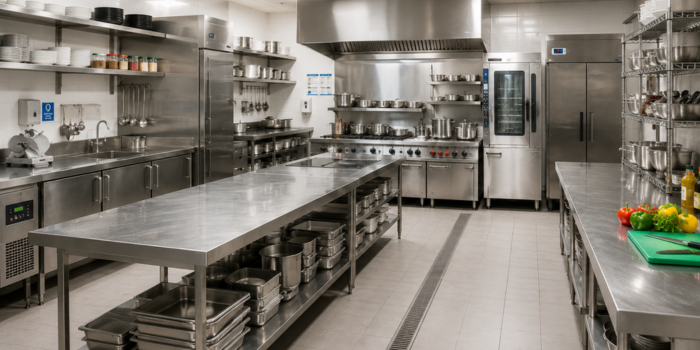
A central kitchen is an important part of many modern food businesses. Instead of preparing food separately at every outlet, a central kitchen allows the business to prepare ingredients, sauces, gravies, bakery products, and other items in one main location. These prepared items can then be sent to different branches, restaurants, cloud kitchens, or catering locations.
A well-planned central kitchen can save time, improve consistency, reduce food waste, and make daily operations easier. However, the kitchen needs the right equipment to handle large quantities of food safely and efficiently.
What Is a Central Kitchen?
A central kitchen is a large food preparation facility designed to support one or more food outlets. It is commonly used by restaurant chains, catering companies, cloud kitchen brands, hotels, bakeries, and food production businesses.
The main idea is simple. Food preparation is done in one controlled location, and the prepared products are distributed to different locations. This allows the business to maintain the same taste and quality across multiple outlets.
For example, a restaurant chain can prepare its basic sauces, spice mixes, chopped vegetables, and partially cooked ingredients in the central kitchen. The ingredients can then be transported to individual branches for final cooking and serving.
Why Equipment Matters in a Central Kitchen
A central kitchen usually handles much larger quantities than a normal restaurant kitchen. Because of this, ordinary kitchen appliances may not be suitable.
The equipment should be strong enough for continuous use and large-volume production. Good equipment also helps employees complete repetitive tasks faster and maintain consistent results.
The right setup can improve:
- Production speed
- Food consistency
- Staff productivity
- Storage management
- Hygiene
- Food safety
- Order preparation
- Distribution efficiency
Investing in reliable Central Kitchen Equipment can therefore have a direct impact on the overall performance of the business.
1. Commercial Cooking Equipment
Cooking equipment is one of the most important sections of a central kitchen. Since large quantities of food may need to be prepared every day, the cooking area should have equipment with suitable capacity.
Depending on the menu, the kitchen may require commercial cooking ranges, large stock pots, steam cookers, tilting pans, deep fryers, ovens, grills, and rice cooking equipment.
For businesses producing large quantities of curries, gravies, rice, sauces, and other prepared foods, high-capacity cooking systems can save considerable time.
2. Food Preparation Equipment
Food preparation is often one of the most time-consuming activities in a central kitchen. Cutting, grinding, mixing, slicing, and kneading large quantities manually can require significant labour.
This is where Commercial Food Preparation Equipment becomes useful.
Equipment such as vegetable cutters, food processors, commercial mixers, dough kneaders, slicers, grinders, and wet grinders can help employees prepare ingredients faster.
For a food business producing the same ingredients every day, preparation machines can also provide better consistency.
3. Commercial Refrigeration
A central kitchen may store large quantities of vegetables, meat, seafood, dairy products, sauces, prepared food, and other ingredients.
Proper refrigeration is essential to maintain freshness and food safety.
Depending on the size of the operation, the kitchen may require refrigerators, freezers, walk-in cold rooms, preparation refrigerators, and other temperature-controlled storage systems.
A well-organized refrigeration area also makes inventory management easier.
4. Dry Storage Systems
Not every ingredient needs refrigeration. Rice, flour, spices, pulses, packaging materials, and other dry products require a clean and organized storage area.
Strong storage racks and shelves help keep ingredients off the floor and make it easier for staff to locate products.
A good dry storage system also helps businesses monitor stock levels and reduce unnecessary food waste.
5. Stainless Steel Work Tables
Preparation areas need strong and hygienic work surfaces.
Stainless steel work tables are commonly used in central kitchens because they are durable, easy to clean, and suitable for heavy daily use.
They can be used for cutting, mixing, portioning, packing, and other preparation activities.
Properly placed work tables can also improve the movement of staff between different kitchen sections.
6. Commercial Mixing and Processing Equipment
Many food businesses prepare sauces, spice mixes, dough, batters, fillings, and other products in large quantities.
Commercial mixers and processing machines can reduce manual work and improve production speed.
For bakeries, food manufacturers, and restaurant chains, these machines can be especially useful because the same recipes may need to be produced repeatedly.
7. Food Portioning Equipment
Consistency is important when supplying food to multiple outlets.
Every branch should receive similar quantities and portion sizes. Portioning equipment can help staff measure and divide prepared food more accurately.
This can improve cost control and reduce food wastage.
For example, sauces, gravies, rice, meat, and other prepared ingredients can be divided into standard portions before distribution.
8. Packing Equipment
After preparation and cooking, food may need to be packed before transportation.
The packing area should have enough workspace for employees to check, portion, label, and seal products.
Depending on the business, packing may include food containers, vacuum packaging, sealing machines, labelling systems, and insulated containers.
A well-organized packing section helps reduce mistakes before products are sent to different outlets.
9. Food Holding Equipment
Some prepared food may need to remain at a suitable temperature before transportation.
Food holding equipment can help maintain quality for a longer period.
Bain maries, heated cabinets, food warmers, and insulated containers can be useful for central kitchens that prepare food in batches.
The right holding system also helps maintain food quality during busy production periods.
10. Commercial Dishwashing Systems
A large central kitchen can generate a significant amount of utensils, trays, containers, and cooking vessels every day.
Manual washing can take considerable time and labour.
Commercial dishwashing systems can help clean large quantities of kitchenware more efficiently. Proper washing areas should also include suitable sinks, drainage, cleaning stations, and space for drying.
11. Exhaust and Ventilation Systems
Large-scale cooking creates heat, steam, smoke, and grease.
A proper ventilation system helps remove these from the kitchen and creates a better working environment for employees.
Commercial exhaust hoods, grease filters, ducts, and fresh-air systems should be planned according to the cooking capacity of the kitchen.
Good ventilation also helps reduce grease accumulation around cooking equipment.
12. Waste Management Area
A central kitchen can produce large amounts of food waste and packaging waste.
A dedicated waste management area helps keep the kitchen clean and organized.
Waste should be handled properly and removed regularly to maintain hygiene and prevent unwanted pests.
Planning the Central Kitchen Layout
Equipment selection is important, but equipment placement is equally important.
A central kitchen should have a logical flow such as:
Receiving → Storage → Preparation → Cooking → Portioning → Packing → Dispatch
This arrangement helps reduce unnecessary movement and allows employees to work more efficiently.
For example, raw ingredients should not need to travel through the finished-food area. Similarly, packed food should have a clear route toward the dispatch area.
How a Central Kitchen Helps Food Businesses
A well-designed central kitchen can provide several business benefits.
It can help maintain the same taste across different outlets, reduce preparation work at individual branches, improve purchasing efficiency, and make inventory management easier.
It can also make it easier for a growing food brand to open new outlets because the central facility can supply prepared ingredients to new locations.
Choosing the Right Equipment
Before purchasing equipment, food businesses should consider their menu, production volume, available space, staff requirements, and future growth.
Buying equipment only because it is inexpensive can create problems later. Low-quality equipment may require frequent repairs and may not handle continuous production.
Instead, businesses should focus on durability, capacity, energy efficiency, ease of cleaning, warranty, and after-sales service.
Reliable Professional Kitchen Equipment can provide better performance and long-term value.
Common Mistakes to Avoid
Some businesses make the mistake of buying equipment before understanding their production requirements. Others may overcrowd the kitchen or forget to leave space for future expansion.
It is also important not to ignore ventilation, refrigeration, storage, drainage, and waste management while planning the cooking area.
A central kitchen should be designed as a complete system rather than simply a room filled with cooking equipment.
Conclusion
A successful central kitchen needs careful planning, the right equipment, and a clear workflow. From commercial cooking systems and food preparation machines to refrigeration, storage, packing, and ventilation, every section has an important role.
Investing in suitable Central Kitchen Equipment can help food businesses improve production speed, maintain consistent quality, reduce waste, and supply multiple outlets more efficiently.
Whether you are running a restaurant chain, catering company, bakery, cloud kitchen, or growing food brand, a well-planned central kitchen can provide the foundation needed to manage larger production and support long-term business growth