Changing the cooking system in a restaurant is not a decision most owners make overnight.
Gas has been part of commercial kitchens for years. Chefs know how it behaves, staff are familiar with it, and the kitchen is already built around it.
So when the idea of moving to induction comes up, the first reaction is often simple:
Is it really worth changing something that already works?
The answer depends on how the kitchen operates, what it costs to run and what the business needs in the future.
For restaurants considering switching from gas to induction cooking, there are several practical factors worth understanding before making the change.
Start With the Reason for the Upgrade
Before looking at equipment, identify why the restaurant is considering the switch.
Is energy consumption becoming a concern?
Is the kitchen becoming too hot?
Is more precise temperature control needed?
Is the restaurant planning a renovation?
Are gas installation or ventilation requirements becoming difficult to manage?
The reason for upgrading should guide the decision.
If the main problem is energy consumption, the restaurant should compare actual operating costs. If heat management is the concern, the kitchen environment should also be considered.
An equipment upgrade works best when it solves a specific business problem.
Gas and Induction Work Differently
The biggest difference is how heat reaches the cookware.
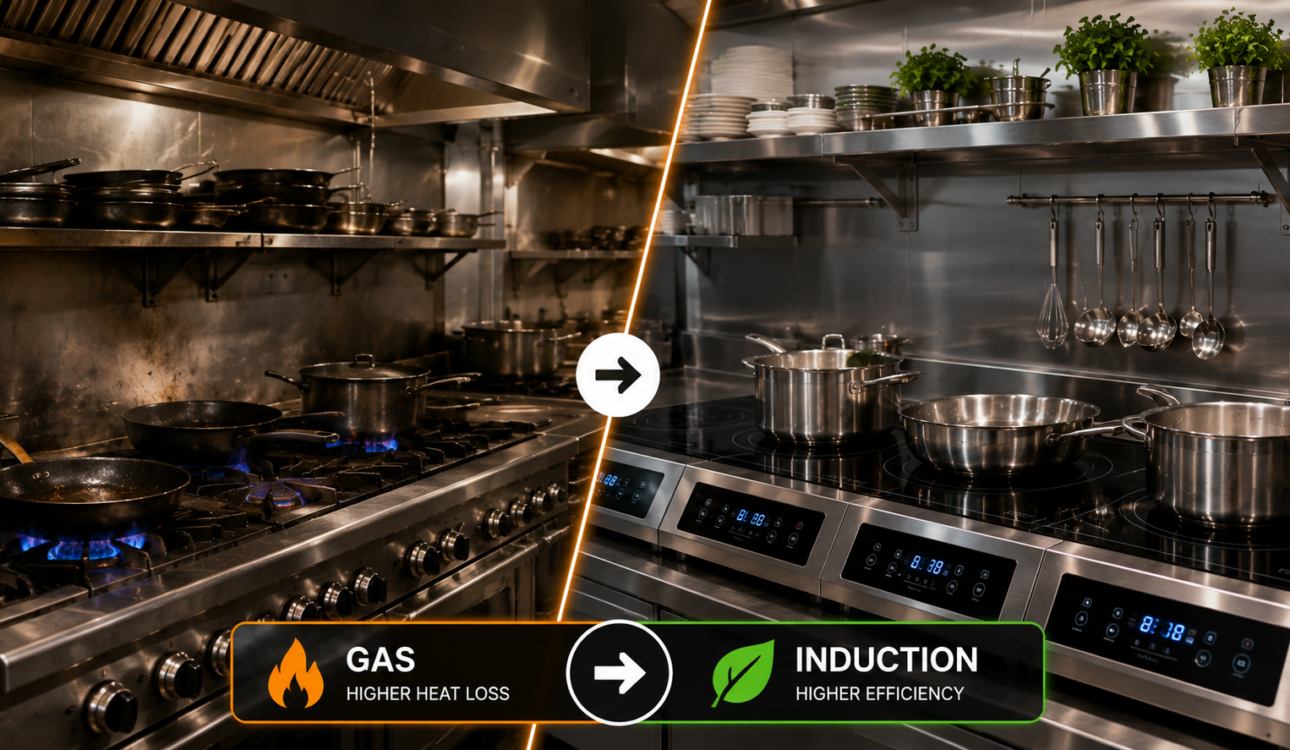
Gas uses a flame to transfer heat to the cooking vessel. Induction uses an electromagnetic field to generate heat directly in compatible cookware.
For chefs, this changes the cooking experience.
Induction can provide very quick adjustments to cooking power. When the heat needs to be reduced, the response can be immediate, which can be useful when preparing dishes that require precise temperature control.
For a busy kitchen, control can be just as important as maximum power.
What About Cooking Speed?
Restaurant owners often worry that moving away from gas could affect service speed.
That is a reasonable concern.
During peak hours, cooking equipment needs to keep up with demand. A slow cooking station can create delays that affect the entire service.
Modern commercial induction equipment for restaurants can provide rapid and responsive heating when properly matched to the cookware and application.
However, performance depends on choosing equipment with suitable power and capacity.
Simply replacing a gas burner with the smallest available induction unit is unlikely to deliver the same production capability.
The equipment needs to be selected according to the actual workload.
Your Cookware May Need to Change
This is one of the practical details that should not be overlooked.
Induction requires cookware that works with its heating system.
Before making the switch, restaurants should check their existing pots and pans. Some may already be compatible, while others may need to be replaced.
The cost of new cookware should therefore be included in the overall upgrade budget.
It is better to identify this requirement before installation than after the new cooking equipment arrives.
Think About the Electrical Infrastructure
Changing from gas to induction is not simply an equipment replacement.
The restaurant also needs to consider its available electrical capacity.
Multiple induction units operating at the same time can require significant electrical power. The existing electrical system should therefore be assessed before the upgrade.
This is especially important for high-volume kitchens where several cooking stations may operate simultaneously during peak service.
Planning the electrical requirements in advance can help avoid unexpected installation problems.
The Kitchen Environment Can Change Too
Anyone who has worked in a busy kitchen knows how hot it can become.
Gas burners produce heat around the cooking area, and several active burners can significantly increase the temperature of the workspace.
Because induction generates heat directly in compatible cookware, less heat is released around the cooking surface compared with conventional flame cooking.
For restaurant teams working long shifts, reducing unnecessary heat in the cooking area can make the environment more comfortable.
It can also influence how the kitchen’s ventilation and cooling systems are used.
Energy Efficiency Needs a Realistic Comparison
Induction is often considered when businesses are looking for better energy management.
But restaurant owners should avoid making decisions based only on general claims about efficiency.
Actual savings depend on the equipment, operating hours, cooking practices, menu, electricity rates and existing gas setup.
The best comparison is based on the restaurant’s own usage.
Look at how many hours the cooking stations operate.
Check current energy consumption.
Understand which stations use the most power.
Then compare the expected operating requirements of the proposed induction system.
This gives the business a more realistic picture of the potential benefit.
Don’t Forget the Kitchen Workflow
An equipment upgrade is also an opportunity to review the way the kitchen operates.
If the cooking stations are already causing congestion, simply replacing the burners will not solve the underlying problem.
The new equipment should fit into the existing workflow.
Can chefs access the cooking surface easily?
Is there enough preparation space?
Can cookware be moved safely?
Will several staff members be able to work at the same time?
A successful induction kitchen upgrade should improve the working environment rather than create new obstacles.
Maintenance and Cleaning Matter
Commercial cooking equipment has to deal with demanding daily use.
It may operate for long periods, experience frequent temperature changes and require cleaning multiple times a day.
Before choosing a system, restaurant owners should understand how it will be cleaned and maintained.
They should also consider the availability of technical support and replacement components.
A small equipment problem during a quiet period may be manageable.
The same problem during a busy dinner service can become a serious operational issue.
Long-term support should therefore be part of the purchasing decision.
Is Induction Right for Every Restaurant?
Not necessarily.
A restaurant with a particular cooking style, specialised cookware or specific production requirements may have reasons to continue using gas or combine different cooking technologies.
The goal should not be to replace gas simply because induction is becoming more popular.
Instead, owners should compare both systems based on their own requirements.
Look at cooking performance.
Consider energy use.
Review installation requirements.
Think about staff familiarity.
Calculate the total cost of ownership.
And consider what the kitchen will need several years from now.
A Hybrid Approach May Also Make Sense
Some restaurants may not need to make a complete switch immediately.
A gradual approach can allow businesses to introduce induction at selected cooking stations and evaluate how it performs in real working conditions.
For example, induction could be introduced for specific cooking tasks where precise temperature control or reduced surrounding heat provides a clear advantage.
This allows the restaurant to learn from actual use before making larger changes.
The best upgrade is not necessarily the biggest one.
It is the one that makes sense for the business.
Gas vs Induction: Look at the Whole Picture
The decision between gas and induction should not be based on one specification.
Both systems have their own characteristics, and the right choice depends on the restaurant’s operation.
Instead of asking which technology is universally better, ask which one fits the kitchen better.
How does the team cook?
What does the menu require?
How busy is the kitchen?
What are the energy costs?
What infrastructure is available?
What kind of working environment does the business want to create?
These questions lead to a much more useful decision.
Conclusion
Moving from gas to induction can be a significant change for a restaurant, but it does not have to be a complicated one.
The key is to look beyond the equipment itself.
Cooking requirements, electrical capacity, cookware, energy use, kitchen workflow, maintenance and long-term operating costs all need to be considered before making the decision.
For some restaurants, induction can provide a practical path towards better control, improved energy management and a more comfortable cooking environment.
At Woltura, we provide induction solutions designed for commercial kitchens where reliable performance, efficient operation and practical day-to-day use matter.
Because upgrading a kitchen is not about choosing the newest technology. It is about choosing the technology that works best for your business.z