Running a busy commercial kitchen is a constant balancing act.
Orders need to go out quickly. Food needs to be prepared consistently. Staff need to keep moving. At the same time, operating costs need to stay under control.
Energy is one of those costs that can quietly grow in the background.
Cooking equipment may be running for several hours every day, sometimes from the first preparation of the morning until the final order at night. When energy consumption increases, restaurant owners naturally start looking for ways to reduce it.
But there is one concern that often comes up:
Can a kitchen reduce energy consumption without sacrificing cooking speed?
The answer can be yes, when the right cooking technology is selected for the right application.
Why Cooking Energy Matters in a Busy Kitchen
Cooking is one of the most energy-intensive activities in many food-service operations.
Traditional cooking methods can produce heat around the cooking area, and some of that heat does not directly contribute to heating the food. This can increase the amount of energy required and make the kitchen environment warmer.
In a busy kitchen, this can also place additional demands on ventilation and cooling systems.
This is where energy efficient induction cooking for restaurants becomes worth considering.
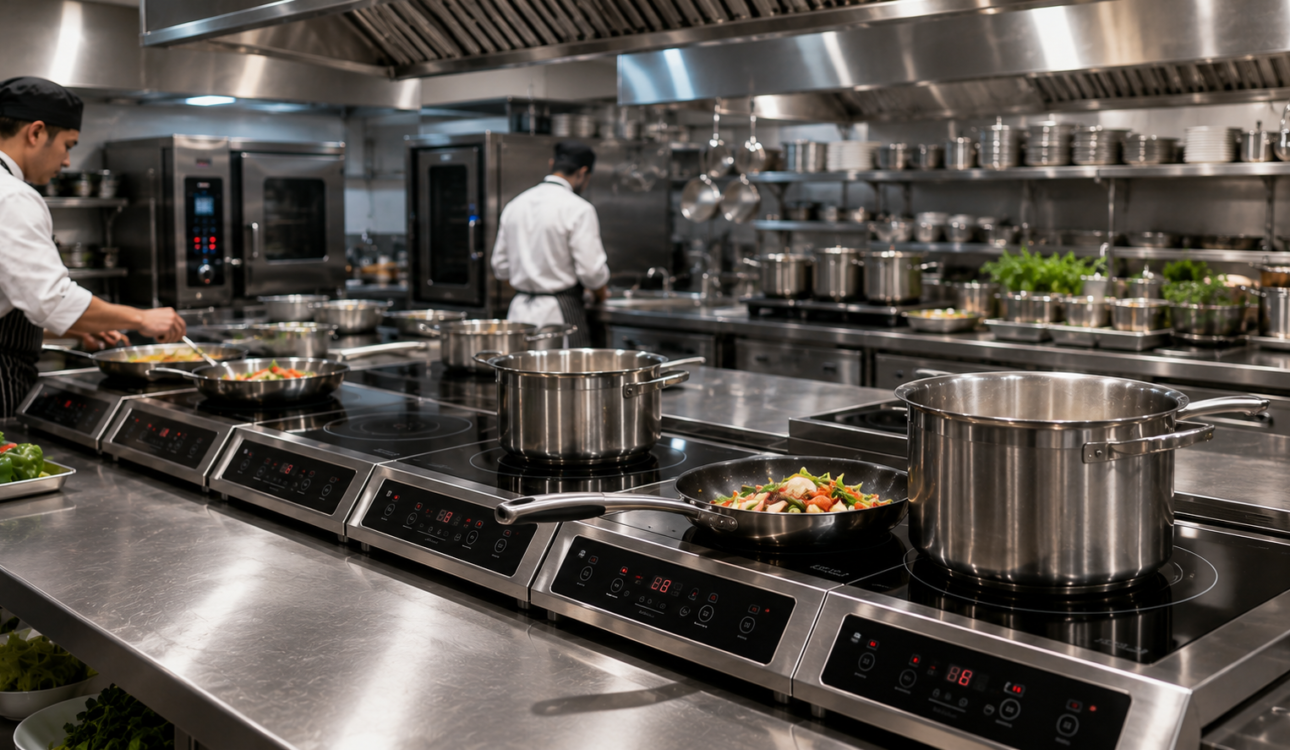
Instead of relying on a flame to transfer heat, induction technology generates heat directly in compatible cookware through electromagnetic energy.
That difference can make the cooking process more targeted.
How Induction Transfers Heat
The basic principle is quite simple.
An induction system creates an electromagnetic field beneath the cooking vessel. When compatible cookware is placed on the cooking zone, the field generates heat within the vessel itself.
The result is direct heat generation rather than heating a flame, burner and surrounding air first.
This can help reduce wasted heat around the cooking area and provide more responsive temperature control.
For a busy kitchen, that responsiveness matters.
When a chef needs to increase or reduce heat, the cooking system can respond quickly, allowing the cooking process to be adjusted without unnecessary delay.
Faster Control Can Support Faster Service
Energy efficiency is useful only if it works with the way a kitchen operates.
A restaurant cannot afford to save energy at the cost of slower service.
This is why the ability to control heat quickly is one of the practical advantages of induction cooking.
During a busy service, chefs may need to move between different cooking temperatures repeatedly. Precise controls can make these adjustments easier and more predictable.
For kitchens handling high order volumes, that can support a smoother cooking process.
The objective is not simply to consume less energy.
It is to use energy more effectively while maintaining the speed and consistency required during service.
Less Wasted Heat Can Improve the Working Environment
There is another benefit that is easy to overlook.
A traditional cooking setup can release considerable heat into the surrounding kitchen.
When several cooking stations are operating at the same time, the combined heat can make the workspace uncomfortable.
Induction cooking generally transfers more of its energy directly to the cookware, which can help reduce unnecessary heat around the cooking surface.
A more comfortable kitchen can make a difference during long shifts, particularly when several chefs are working close together.
It can also support the overall ventilation and cooling requirements of the space.
Choosing Equipment Based on Actual Kitchen Needs
Not every restaurant needs the same cooking setup.
A small café with a limited menu may have very different requirements from a hotel kitchen or a high-volume restaurant.
Before choosing induction cooking equipment for commercial kitchens, businesses should consider several practical factors.
How many meals are prepared during peak periods?
What types of dishes are cooked?
How many cooking stations are needed?
What cookware is currently being used?
How much space is available?
What electrical capacity is available at the site?
These questions help determine whether induction is suitable and what type of equipment would make sense.
Power Rating Is Not the Whole Story
It is easy to compare cooking equipment simply by looking at its power rating.
But real-world efficiency depends on how that power is used.
A system that provides precise control can allow chefs to adjust heat according to the cooking requirement instead of continuously operating at a higher setting than necessary.
Good cooking practices also matter.
Keeping suitable cookware centred on the cooking zone, using appropriate vessel sizes and selecting the right power level can all contribute to more effective energy use.
Technology works best when it is combined with sensible operation.
Think About the Full Cost, Not Just the Electricity Bill
When restaurant owners consider an equipment upgrade, electricity savings are only one part of the calculation.
There may also be benefits related to cooking control, heat management, cleaning and daily workflow.
At the same time, the initial investment, electrical installation requirements, cookware compatibility and maintenance should all be considered.
The right decision depends on the individual kitchen.
This is why simply choosing the cheapest equipment or the most powerful model may not always produce the best long-term result.
Can Induction Keep Up During Peak Hours?
This is one of the most important questions for restaurant owners.
A kitchen may operate comfortably during quiet periods, but peak service is where equipment is truly tested.
When multiple orders arrive at the same time, cooking equipment needs to provide consistent performance without creating unnecessary delays.
A properly selected induction system can provide responsive heat control and repeatable cooking conditions, which can be useful in high-volume environments.
However, equipment capacity still needs to match the workload.
If the kitchen regularly exceeds the capacity of its cooking stations, changing the cooking technology alone will not solve the problem.
The entire workflow needs to be considered.
Energy Savings Start With Better Planning
Switching to induction is not a magic solution for every energy problem.
Kitchen layout, operating hours, equipment usage, maintenance and cooking practices all influence energy consumption.
For example, leaving equipment running unnecessarily during quiet periods can waste energy regardless of the cooking technology being used.
Likewise, poorly planned workflows can increase cooking and preparation time.
So the most effective approach is to look at the entire operation.
Where is energy being used?
When is it being used?
Which equipment runs the longest?
Where is heat being wasted?
And which parts of the process can be improved?
Once these questions are answered, an equipment upgrade becomes a more informed decision.
Is It Time to Consider Induction?
For restaurants looking to improve energy management while maintaining cooking performance, induction can be a practical option.
It offers direct heat generation, responsive control and a cooking surface that can be easier to manage in a busy environment.
But the right solution depends on the kitchen.
A restaurant should consider its menu, production volume, available power, cookware and workspace before making the switch.
The goal should not be to follow a trend.
It should be to choose a cooking system that makes sense for the way the kitchen actually works.
Conclusion
Reducing energy costs in a busy restaurant does not necessarily mean slowing down service.
With the right setup, better heat control and suitable equipment can help a kitchen use energy more effectively while maintaining the cooking speed required during peak hours.
For businesses considering reduce energy costs in commercial kitchens, induction can be one part of a wider strategy that includes efficient equipment, sensible operation and better kitchen planning.
At Woltura, we provide induction cooking solutions designed for commercial food-service environments where performance, efficiency and reliable day-to-day operation matter.
Because the best kitchen is not the one that simply uses less energy. It is the one that uses energy intelligently while keeping service moving.