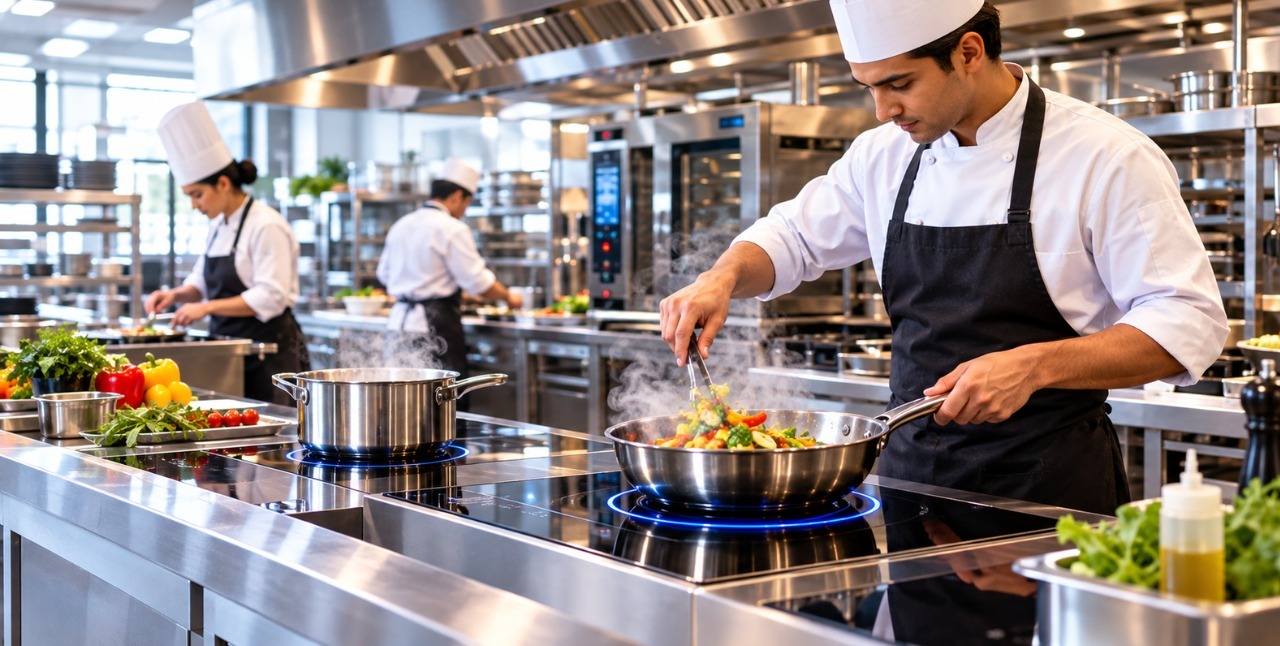
Commercial kitchens in restaurants, hotels, hospitals, and catering facilities often operate for long hours. During busy service periods, cooking equipment must handle continuous use while maintaining consistent performance. With the growing demand for energy-efficient cooking solutions, commercial induction cooking equipment is becoming an option for professional kitchens.
However, one common question among restaurant owners and kitchen managers is whether a commercial induction cooker can handle continuous 12-hour kitchen operations.
The answer depends on several factors, including equipment quality, power capacity, cooling systems, installation, and maintenance. Understanding these factors can help businesses determine whether induction cooking is suitable for their daily kitchen requirements.
1. Can Commercial Induction Cookers Operate for 12 Hours?
Commercial induction cookers designed for professional kitchens can support extended operating hours, provided they are used within the manufacturer’s specifications.
Unlike domestic induction cooktops, commercial induction ranges are designed to meet the demands of professional food preparation. However, not every model is suitable for continuous 12-hour operation.
The equipment’s power rating, cooling system, construction, and recommended duty cycle should be considered before selecting a model.
Restaurants that operate throughout the day should choose commercial induction equipment specifically rated for their expected workload.
2. The Importance of a Reliable Cooling System
A cooling system plays an important role in the long-term performance of commercial induction cooking equipment.
Induction cookers contain electronic components that generate heat during operation. When equipment operates for extended periods, these components require effective cooling to maintain suitable operating temperatures.
Many commercial induction ranges use built-in fans to circulate air and prevent excessive heat buildup.
If the cooling system is blocked by dust, grease, or poor ventilation, the equipment may overheat. Some models automatically reduce power or shut down to protect internal components.
Therefore, choosing an induction cooker with an appropriate cooling system and maintaining clear ventilation openings are essential for long operating hours.
3. Power Capacity and Continuous Cooking Performance
Power capacity directly affects how a commercial induction cooker performs during busy kitchen operations.
Restaurants preparing large quantities of food may require equipment with higher power ratings to support their cooking requirements.
However, operating an induction cooker continuously at maximum power can place greater demands on its electrical and cooling systems.
Selecting equipment with a suitable power rating helps ensure that the cooker can handle the expected cooking workload.
4. Build Quality and Equipment Durability
Commercial kitchens require equipment that can withstand frequent use, high workloads, and demanding working conditions.
The durability of a commercial induction cooker depends on the quality of its internal electronic components, cooking surface, housing, and overall construction.
Equipment designed specifically for commercial applications is generally better suited to demanding kitchen environments than domestic models.
Restaurant owners should review the manufacturer’s specifications, recommended operating hours, warranty conditions, and availability of servicing before investing in an induction range.
Choosing equipment that matches the kitchen’s daily workload can help reduce unexpected.
5. Energy Efficiency During Long Operating Hours
Energy consumption is an important consideration for commercial kitchens that operate for 12 hours or more each day.
Induction cooking transfers energy directly to compatible cookware, reducing heat loss compared with many conventional cooking methods.
This can make induction cooking an energy-efficient option for professional kitchens.
However, electricity consumption depends on the equipment’s power rating, cooking temperature, operating duration, and workload.
6. Temperature Control During Extended Cooking
Maintaining consistent cooking temperatures is essential during long kitchen operations.
Commercial induction cookers offer adjustable temperature and power settings, allowing chefs to control the heat according to the dish being prepared.
For example, boiling, frying, simmering, and sautéing all require different heat levels.
For kitchens with continuous food preparation requirements, choosing an induction cooker with responsive and reliable controls is important.
7. The Role of Proper Installation
Even high-quality commercial induction equipment may experience performance problems if it is installed incorrectly.
Proper installation involves checking the electrical supply, ventilation requirements, equipment clearance, and the manufacturer’s installation instructions.
An unsuitable electrical connection can affect equipment operation and create safety risks.
Professional installation helps ensure that commercial induction cookers operate under the conditions specified by the manufacturer.
For kitchens planning to operate throughout the day, installation requirements should be considered during the commercial kitchen design stage.
8. Regular Maintenance for 12-Hour Operations
Regular maintenance is essential for commercial induction cookers used for extended periods.
Continuous operation can expose equipment to grease, dust, food spills, and general wear. Without proper cleaning and servicing, these factors may affect performance.
Some important maintenance practices include:
- Cleaning the cooking surface regularly.
- Keeping air inlets and outlets free from dust and grease.
- Checking the cooling fan according to the manufacturer’s instructions.
- Inspecting electrical connections during scheduled servicing.
- Following the manufacturer’s recommended maintenance schedule.
Regular maintenance can help identify potential issues before they cause unexpected equipment downtime.
Restaurants should also ensure that kitchen staff understand the correct operating procedures for their induction equipment.
How Chef Style Kitchen Equipment Supports Modern Kitchens
Chef Style Kitchen Equipment provides commercial kitchen equipment solutions, including kitchen design, fabrication, and installation for professional food service establishments.
From selecting suitable cooking equipment to planning functional kitchen layouts, proper equipment selection is important for supporting smooth kitchen operations.
For restaurants and hotels considering commercial induction cooking, evaluating power requirements, ventilation, and operating conditions can help ensure that the selected equipment meets their needs.
Conclusion
Commercial induction cooking equipment can support extended kitchen operations, including 12-hour working schedules, when the equipment is specifically designed for continuous use and operated according to the manufacturer’s guidelines.
Its actual performance depends on several factors, including power capacity, cooling systems, build quality, electrical installation, and regular maintenance.
For restaurants, hotels, and catering businesses, selecting the right commercial induction cooker requires careful planning. By considering operating hours and cooking requirements before purchasing equipment, businesses can make informed decisions and create efficient professional kitchens.