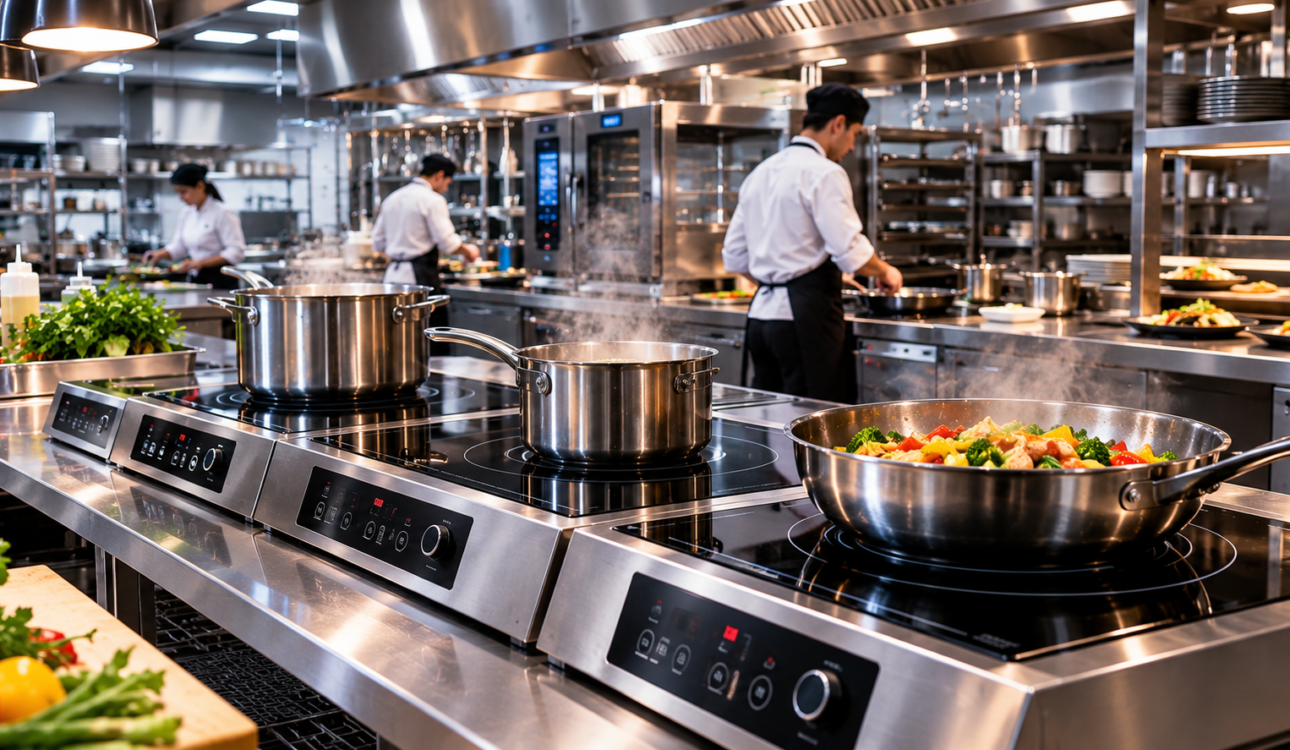
A busy restaurant kitchen does not get a second chance during peak service.
When dozens of orders arrive within a short period, every cooking station needs to perform. Heat needs to be consistent, chefs need quick control, and equipment needs to keep up without becoming another source of delay.
This is why choosing cooking equipment for a high-volume kitchen requires more thought than simply comparing specifications.
For restaurants considering induction, the real question is not whether induction works.
It is whether the equipment is right for the way the kitchen operates.
High-Volume Cooking Changes the Requirements
A cooking system that works perfectly in a small café may not be suitable for a restaurant serving hundreds of meals a day.
High-volume kitchens place greater demands on equipment.
Cooking stations may operate continuously during service. Different dishes may require different temperatures at the same time. Staff may need to move quickly between preparation and cooking areas.
This is where induction cooking for high-volume restaurants can offer practical advantages.
Induction provides direct heat to compatible cookware and allows chefs to adjust the cooking power quickly. For a busy kitchen, that level of control can be useful when several dishes are being prepared simultaneously.
Start With the Menu
Before selecting equipment, restaurant owners should look at what they actually cook.
A kitchen focused on sauces and simmering may have different requirements from one preparing stir-fries, boiling large quantities or handling heavy cookware.
The menu determines the type of cooking the equipment needs to support.
This is an important step because there is no single induction setup that is ideal for every restaurant.
The right choice starts with understanding the cooking process.
Consider the Peak Hour, Not the Average Hour
One of the biggest mistakes when planning a commercial kitchen is calculating equipment requirements based on a normal working period.
The real test comes during the busiest hour.
How many dishes need to be cooked at the same time?
How many burners are normally occupied?
How often do chefs need to change temperatures?
Are multiple cooking stations running continuously?
These questions provide a much better picture of the equipment capacity required.
A kitchen that performs well during a quiet afternoon but struggles during dinner service has not really solved its capacity problem.
Power and Control Both Matter
When comparing commercial induction cooking equipment, power is naturally one of the first specifications people look at.
But power alone does not determine whether a system is suitable.
Control is equally important.
Chefs need to be able to adjust heat according to the dish being prepared. Too much heat can affect food quality, while insufficient heat can slow down the cooking process.
Responsive controls can make it easier to move between different cooking requirements during a busy service.
The best equipment should provide enough power for the workload while giving chefs the control they need.
Think About the Cookware
Induction cooking requires compatible cookware.
This is something restaurants should consider before making an equipment decision.
If a kitchen is replacing an existing cooking system, the current cookware should be checked for induction compatibility. If new cookware is required, that additional cost should be included when evaluating the upgrade.
Cookware size also matters.
The vessel should be appropriate for the cooking zone and the quantity of food being prepared. Using cookware that is poorly matched to the cooking zone can affect cooking performance.
A good equipment decision therefore considers the complete setup, not just the induction unit itself.
Space Is Valuable in a Busy Kitchen
High-volume kitchens often have limited working space.
Every piece of equipment needs to earn its place.
An induction system can be useful where flexible cooking stations or compact equipment arrangements are required. But the final decision should still consider the complete workspace.
Can chefs move comfortably?
Can cookware be transferred easily?
Is there enough preparation space nearby?
Can staff access the cooking area without blocking others?
A cooking appliance may have excellent technical specifications, but if it creates a workflow problem, the kitchen may not become more efficient.
Cleaning and Maintenance Matter Too
In a professional kitchen, equipment is used repeatedly and cleaned frequently.
That means maintenance should be considered before purchasing.
A cooking surface that is straightforward to clean can make daily closing procedures easier. Accessible controls and a practical design can also help staff maintain the equipment properly.
Restaurants should also consider service support and replacement requirements.
Equipment downtime during a busy service can be far more costly than the maintenance itself.
Choosing equipment from the beginning with long-term operation in mind can help reduce unnecessary interruptions.
Safety Should Be Part of the Decision
High-volume kitchens are demanding workplaces.
Several people may be working around hot cooking stations at the same time, often under significant time pressure.
This makes safety an important consideration when selecting induction equipment for busy restaurant kitchens.
Features such as controlled heating, appropriate installation and a well-planned workspace can contribute to safer daily operation.
However, equipment is only one part of kitchen safety.
Staff training, proper procedures, regular cleaning and maintenance all remain essential.
Energy Use Still Matters
A restaurant operating multiple cooking stations for several hours a day can consume a significant amount of energy.
Induction can help make heat transfer more targeted because heat is generated in compatible cookware rather than relying on a conventional flame to heat the vessel.
But the actual benefit depends on how the equipment is operated.
Using the appropriate power level, switching equipment off when it is not required and maintaining an efficient workflow all contribute to better energy management.
The objective is not simply to buy efficient equipment.
It is to use it efficiently.
Don’t Choose Equipment Based Only on Price
Initial purchase price is important, but it should not be the only factor.
A cheaper unit may not provide the capacity required during peak service.
Likewise, an expensive system may include features that a particular restaurant never needs.
A better comparison looks at the complete picture:
- Cooking capacity
- Power requirements
- Control and responsiveness
- Cookware compatibility
- Available workspace
- Cleaning and maintenance
- Expected usage
- Long-term operating costs
This makes the purchasing decision more closely connected to the actual needs of the business.
Build Around the Way Your Kitchen Works
The best equipment decision usually comes after observing the kitchen.
Watch the team during peak service.
Notice where delays happen.
Identify which cooking stations are busiest.
Look at the dishes that take the longest to prepare.
Understand where staff movement becomes difficult.
Then choose equipment that addresses those specific requirements.
This approach is much more reliable than selecting equipment simply because it is modern or popular.
Conclusion
For a high-volume restaurant, cooking equipment needs to do more than produce heat.
It needs to support speed, consistency, control and the way the kitchen operates throughout a busy service.
Choosing induction cooking equipment should therefore begin with the restaurant’s menu, workload, available space and daily workflow.
The right system can help chefs manage demanding service periods more effectively while supporting better energy use and a more organised working environment.
At Woltura, we focus on induction cooking solutions for commercial food-service environments where performance, efficiency and dependable operation are important.
Because in a busy kitchen, the right equipment is not simply about cooking faster. It is about helping the entire operation keep moving.