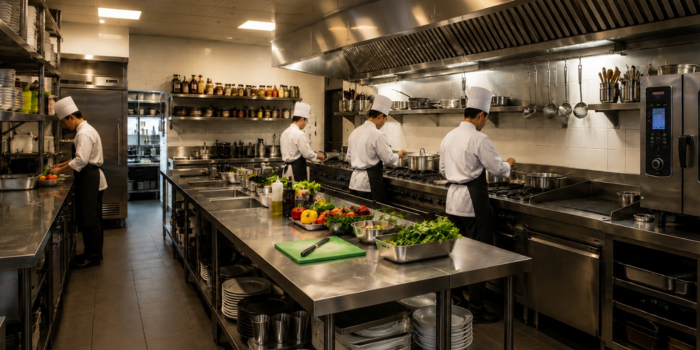
The success of every high-performing restaurant begins behind the kitchen doors. While customers experience delicious food and timely service, a carefully planned system works silently in the background to make every order possible. From receiving ingredients to plating the final dish, every activity follows a structured process that allows staff to work efficiently without unnecessary delays.
A well-planned Commercial Kitchen Workflow helps restaurants handle large order volumes, maintain consistent food quality, and improve customer satisfaction even during peak business hours. Instead of relying solely on additional staff or larger kitchen spaces, successful restaurants focus on building organized systems that eliminate wasted time and improve coordination.
Hotels, restaurants, cloud kitchens, catering businesses, and institutional kitchens all benefit from creating a workflow that supports smooth operations while reducing operational costs. An efficient workflow not only increases productivity but also creates a safer, cleaner, and more professional working environment.
Understanding the Importance of Workflow
Workflow refers to the movement of ingredients, employees, equipment, and completed dishes through every stage of kitchen operations. Each step should connect naturally with the next, allowing food to move from storage to preparation, cooking, plating, and service without interruption.
An efficient workflow provides several advantages:
- Faster food preparation
- Better staff coordination
- Reduced waiting time
- Consistent food quality
- Improved workplace safety
- Lower operational costs
When every department understands its responsibilities, the kitchen operates as one coordinated system instead of separate work areas.
Build the Right Kitchen Layout
An efficient kitchen always begins with proper planning. The layout should allow employees to perform their duties comfortably while minimizing unnecessary movement.
A carefully planned Commercial Kitchen Design ensures that workstations are positioned according to the natural flow of daily operations.
An ideal layout generally includes:
- Receiving and storage section
- Preparation station
- Cooking area
- Plating counter
- Cleaning section
- Waste disposal zone
Positioning these areas correctly reduces congestion and helps employees complete tasks more efficiently.
Organize Every Workstation
Every workstation should contain everything employees need to complete their assigned tasks.
Preparation stations should include:
- Knives
- Cutting boards
- Measuring tools
- Frequently used ingredients
- Mixing containers
Cooking stations should include:
- Cooking appliances
- Cooking utensils
- Oils and seasonings
- Safety equipment
- Cleaning cloths
Keeping tools and ingredients within easy reach improves productivity while reducing unnecessary movement.
Improve Daily Kitchen Operations
Efficient Restaurant Kitchen Management focuses on creating clear operating procedures that every employee follows consistently.
Daily operational practices should include:
- Assigning clear responsibilities
- Preparing ingredients before service
- Organizing workstations
- Maintaining cleanliness
- Monitoring inventory
- Reviewing daily production
Standardized procedures reduce confusion while improving food quality and operational consistency.
Invest in Reliable Equipment
Equipment has a significant impact on workflow efficiency. Restaurants should invest in equipment that delivers reliable performance while supporting continuous production.
Choosing quality Industrial Kitchen Equipment provides several operational advantages.
Benefits include:
- Faster cooking performance
- Better temperature control
- Reduced maintenance
- Improved energy efficiency
- Greater durability
- Increased workplace safety
Reliable equipment minimizes unexpected downtime and allows staff to maintain productivity during busy service hours.
Reduce Unnecessary Movement
Every unnecessary step inside the kitchen reduces efficiency. Employees should spend more time preparing food and less time walking between workstations.
Simple improvements include:
- Positioning ingredients closer to preparation areas
- Organizing storage shelves
- Keeping walkways clear
- Locating utensils near workstations
- Separating preparation and cleaning zones
Reducing movement helps employees work more comfortably while increasing operational speed.
Strengthen Communication
Strong communication allows kitchen teams to respond quickly to changing customer demands.
Restaurants can improve communication by:
- Holding pre-shift meetings
- Using kitchen display systems
- Assigning dedicated responsibilities
- Confirming special orders
- Reviewing completed service
Better communication helps prevent mistakes and keeps food moving efficiently through every stage of production.
Maintain Clean and Safe Work Areas
A clean kitchen supports both productivity and food safety.
Daily cleaning routines should include:
- Sanitizing workstations
- Cleaning equipment
- Removing waste regularly
- Organizing storage
- Maintaining clear walkways
Employees perform more efficiently when working in a clean and organized environment.
Monitor Performance Regularly
Continuous improvement requires regular evaluation.
Managers should monitor:
- Order completion time
- Staff productivity
- Food preparation speed
- Equipment performance
- Customer feedback
- Inventory usage
Tracking these areas helps identify opportunities to improve daily operations.
Focus on Continuous Improvement
Every successful restaurant continually looks for ways to improve its operations.
Achieving Kitchen Productivity Improvement requires businesses to evaluate workflows, train employees, maintain equipment, and update operational procedures whenever necessary.
Continuous improvement may include:
- Staff training
- Equipment upgrades
- Better inventory management
- Workflow adjustments
- Technology adoption
- Performance reviews
Small improvements made consistently often produce significant long-term results.
Prepare for Future Growth
As customer demand increases, commercial kitchens should be prepared to expand production without disrupting daily operations.
Future planning should consider:
- Additional equipment capacity
- Flexible workstation layouts
- Increased storage
- Staff development
- Preventive maintenance
- Operational scalability
Planning ahead allows businesses to respond confidently to future opportunities.
Conclusion
High-performing restaurants do not succeed by chance. Their success comes from careful planning, organized workflows, skilled employees, reliable equipment, and continuous operational improvement. Every stage of the kitchen process should support speed, consistency, safety, and quality. Businesses that invest time in improving workflow can increase productivity, reduce operational costs, strengthen customer satisfaction, and create a kitchen environment that supports sustainable long-term growth. An efficient commercial kitchen is not simply a place where food is prepared—it is the foundation of a successful hospitality business